
 dudeoi
Scarface is a film I’ve watched countless times, yet for years I never thought much about it. Everything seemed obvious almost exaggerated, even over the top. It wasn’t until I approached my 40s that I began to appreciate the depth of its themes and the surprisingly profound lessons hidden beneath its surface.
In this article, we’ll explore the deeper lessons Brian De Palma was trying to convey through Scarface.

OUR SPONSOR OF THE DAY : NEONNIGHT.FR

The plot

Scarface follows Tony Montana, a Cuban immigrant who arrives in Miami with nothing after the 1980 Mariel boat lift. Driven by ruthless ambition and an insatiable hunger for power, he rises from a small-time criminal to the head of a vast drug empire. But as his wealth and influence grow, so do his paranoia, ego, and addiction, ultimately setting him on a path toward self-destruction.
Scarface: Ego as a Self-Destruction Mechanism
Tony Montana does not fall in spite of what made him successful. He falls because of it—at the same dosage, applied without variation to a context that would have required something else. This is the film’s central idea; everything else is merely a variation of it.
1. Ego Has Only One Setting
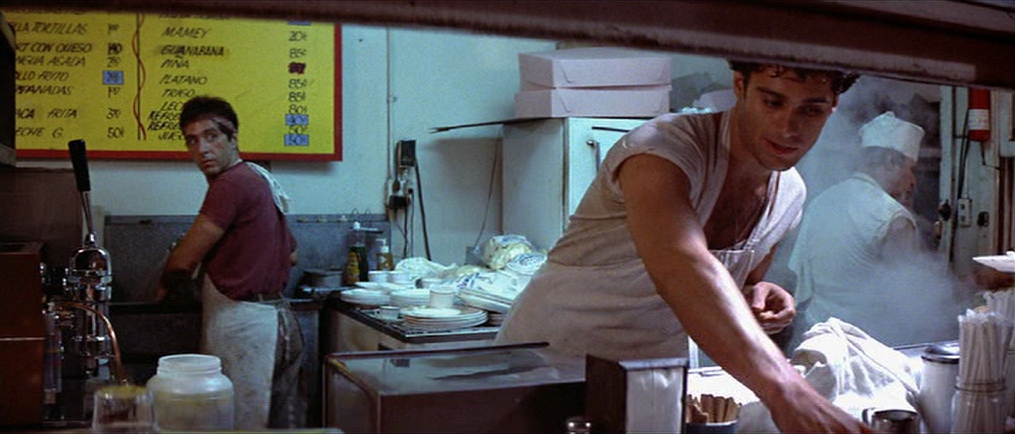
The classic misunderstanding is to read Tony as a man whose confidence “slips” into arrogance over time, as if a dial slowly turns. But De Palma shows no such drift: the trait is identical in intensity from beginning to end. What changes is the relationship between the trait and its environment.
In the slums of Havana or the immigrant camp, Tony’s rigidity is a survival skill. At the top of his empire, the same rigidity toward partners, a woman, a cartel becomes pathological.
So the film is not saying “too much confidence destroys.” It suggests something more unsettling: no character trait has a fixed value. Its function depends entirely on the context it operates in. Tony has no second mode. He is a single-parameter system, incapable of recalibration what he calls loyalty to himself is in fact a total absence of psychological flexibility.
2. Money Fills Nothing Because It Was Never the Goal
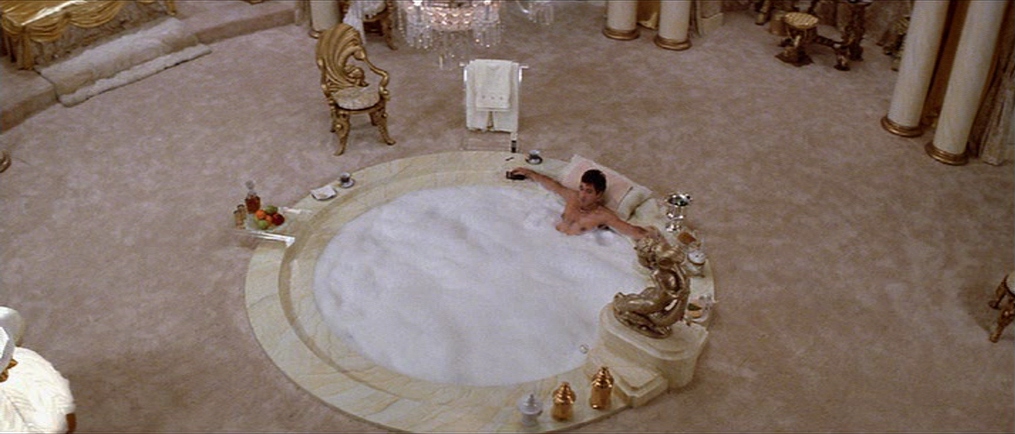
It would be a mistake to read Tony’s accumulation as greed. It is not. Tony does not actually want what money buys: the gold office, the tiger, the mansion all of it has no functional value for him, only evidential value. What he seeks is external, constant confirmation of his own existence, because he has no internal mechanism to produce it.
This is why hedonic adaptation is not simply “never enough” it is diagnostic. A pleasure that fades with repetition reveals it was never pursued for itself, only as currency for recognition. And recognition never arrives, because the kind he seeks cannot come from the outside. It would require an internal stability he does not possess.
The lack is not quantitative. It is structural. No amount can resolve it because the demand is addressed to the wrong system.
3. Control Produces the Opposite of What It Aims For
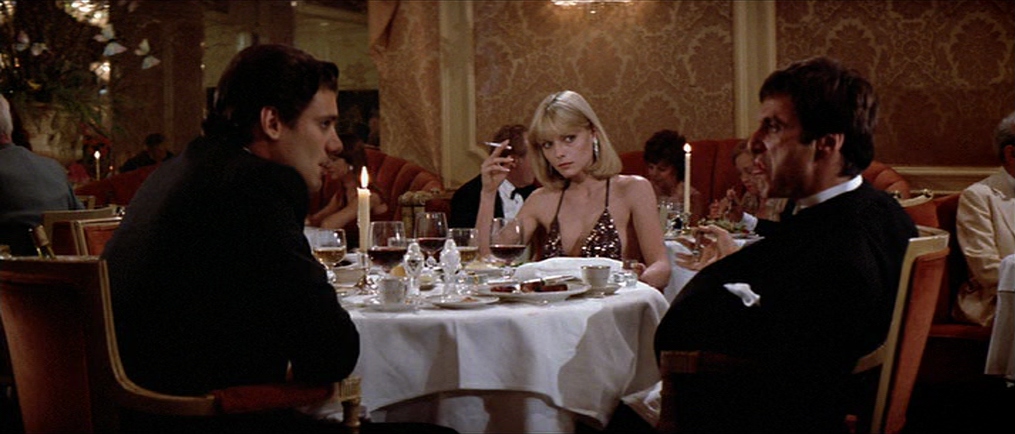
As Tony tightens his grip on his environment eliminating rivals, surveilling Gina, suspecting Manny he does not secure anything. He systematically creates the conditions of his own isolation and betrayal.
Each act of control removes another potential source of correction, contradiction, or genuine loyalty. It is a self-reinforcing loop: the more he controls, the more alone he becomes; the more alone he is, the less reliable information he has about real threats; the less information he has, the more control he feels he needs.
The film does not depict a powerful man who becomes paranoid. It shows that control and paranoia are the same process seen from different angles you cannot have one without generating the other.
4. The “Monster” as a Social Function, Not an Anomaly
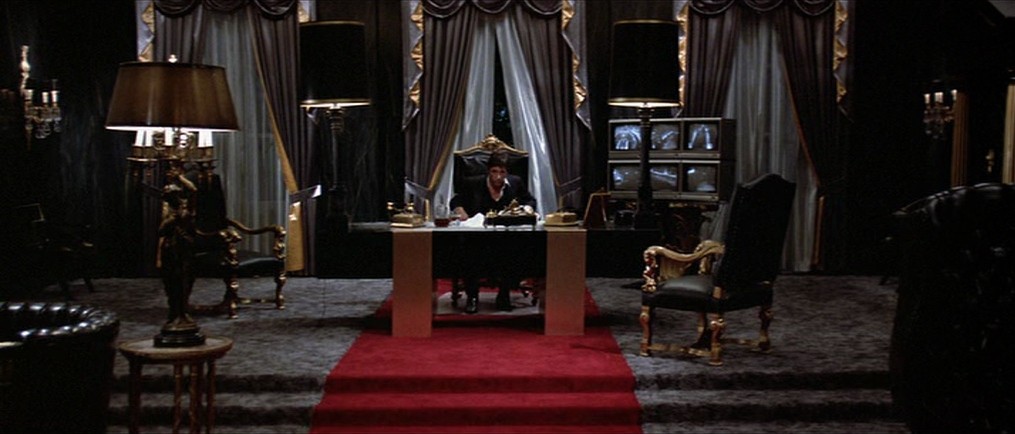
The restaurant scene “you need people like me” is the only moment where Tony expresses a form of lucidity beyond his personal situation. He does not claim innocence. He argues that society’s disgust toward him is part of its structure: someone must occupy the position of absolute excess so others can define themselves as restrained by contrast.
This is not a justification, even if Tony uses it as one. It is an observation that holds independently of him: the system that produces him (easy cocaine money, the absence of legitimate pathways for a refugee) and the system that condemns him are the same system.
The film does not ask for sympathy for Tony. It simply refuses the illusion that his fall resolves the problem he reveals.
What the film ultimately shows is a psyche without internal regulation, placed in an environment that rewards precisely that lack of regulation until the same environment shifts phase and demands what it never developed. Tony does not lose control at the end. He continues applying the only strategy he has ever known, in a world that has stopped rewarding it.
5. Legal power and criminal power are the same substance, not two opposing worlds.
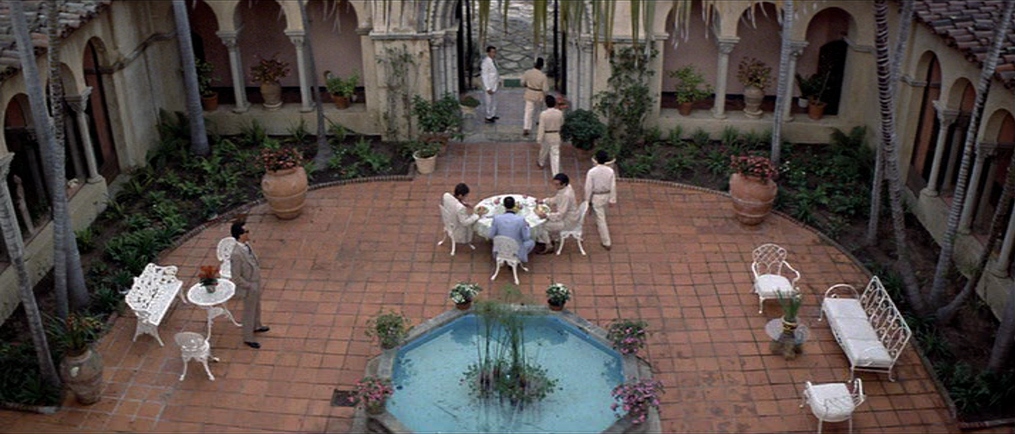
The film carefully shows that Sosa, the major Bolivian supplier, deals with a corrupt diplomatic attaché the scene in which the latter refuses the mission (killing the journalist and her children) and is subsequently eliminated reveals that the boundary between the state and the cartel does not exist at a structural level, only at the level of appearance.
State power is not threatened by organized crime: it is one of its business partners, among others, with its own margins of negotiation. Scarface rejects the comforting fiction of crime as something “external” to the system it is simply a subcontractor.
6. Institutional corruption is portrayed as a condition of access, not an accident.
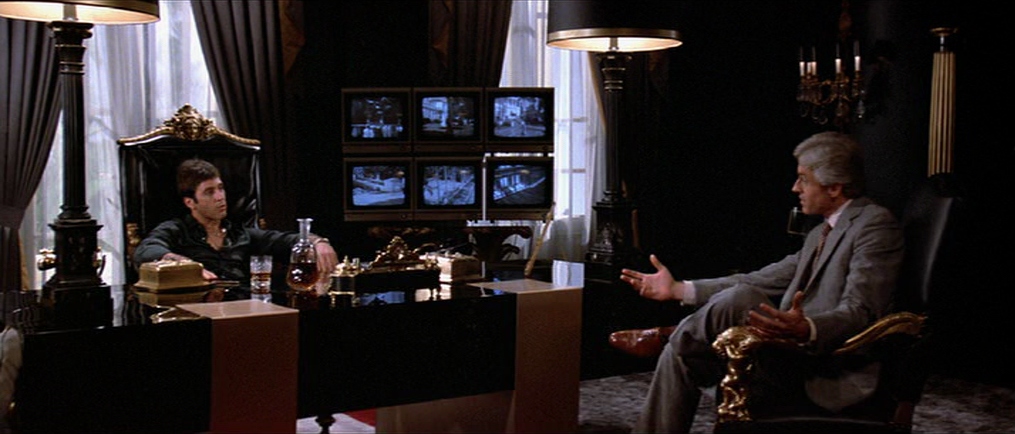
Tony could never have built his empire without the bankers who launder his money, the police officers he bribes, and the lawyers who structure his shell companies.
The film does not dwell on this—precisely because that is the point: this infrastructure is so normalized that it does not even require dedicated scenes. Corruption is not a flaw in the American system that Tony exploits; it is a core feature, available to anyone with enough cash to activate it.
The final point, the hardest one
The film does not criticize crime as a deviation from capitalismi t presents crime as its unvarnished version.
Remove the language of legitimacy (shareholders, HR, compliance, corporate social responsibility) from a company structured around maximum extraction at any human cost, and you get Tony Montana.
The difference is not one of nature, but of packagingand that is precisely why the film remains unsettling forty years later: it never explicitly talks about legal enterprise, yet it would not need to change anything structurally for it to apply to it.
7. On Tony’s ambition
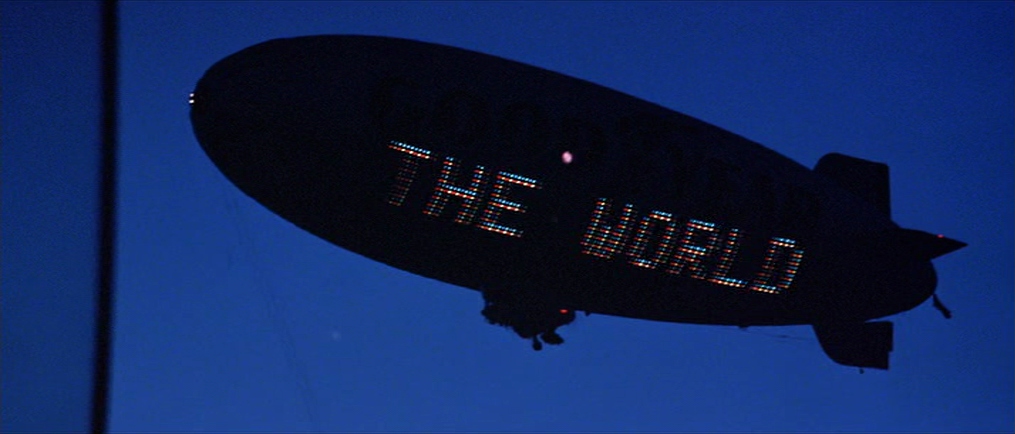
What Tony wants — a beautiful house, a beautiful woman, being respected when he walks into a room — isn’t excessive by nature. It’s close to a species-standard desire set. Greed implies wanting more than enough; but the film barely lets us see Tony wanting quantity for its own sake. He wants status objects that other people recognize as status objects.
That’s not greed, that’s mimetic desire — wanting what confers position in the eyes of others, which is a completely different mechanism. The tell is that none of it satisfies him once he has it (the mansion bores him, Elvira becomes furniture he barely looks at). If it were genuine appetite, possession would produce at least temporary satiation.
It doesn’t, because the target was never the object — it was the recognition the object was supposed to purchase. So the real diagnosis isn’t “he wants too much,” it’s “he’s using external objects to solve an internal problem they were never designed to solve.” That’s a much harder thing to indict him for, because it’s not a moral failing it’s a design flaw in how status-seeking works for everyone, just running at full amplitude in him with no counterweight.
Which means the film’s judgment of Tony’s ambition is actually more ambiguous than the listicle version admits. If wanting beauty and respect is just being human, then what’s being punished isn’t the desire it’s the fact that he had exactly one channel available to pursue it, and that channel had no ceiling and no brakes built in. A man with the same appetite born into a different class, with legal channels available, becomes a CEO, not a corpse in a fountain of blood on his own fountain staircase.
8. On the mother’s obedience
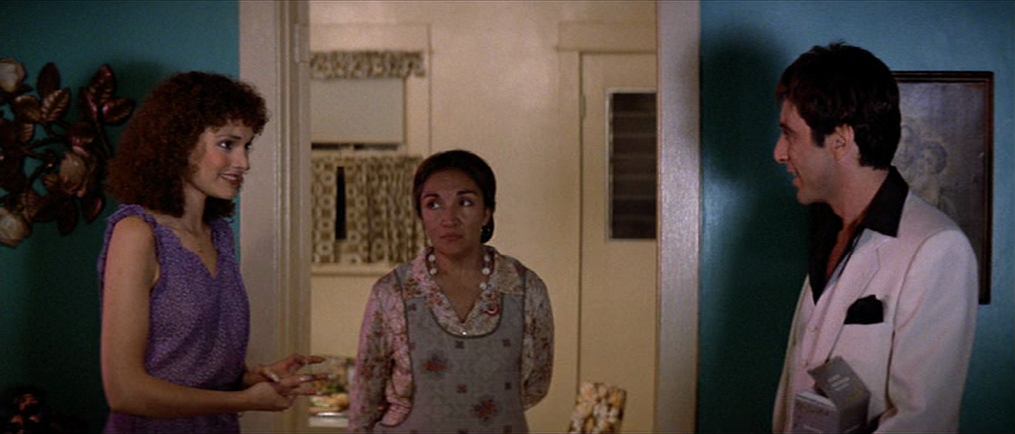
The conventional read casts her as the moral anchor: humble, honest, rejects tainted money, therefore right. But look at what her position actually costs her and what it actually contains. She works a factory job her whole life, in a system that offers her nothing beyond subsistence, and her response to that is not resistance it’s identification with the limit itself.
She doesn’t say “this system underpays and diminishes people like me and that’s wrong.” She says, in effect, “smallness is virtue, and my son’s refusal of smallness makes him a criminal in more than the legal sense.” That’s not neutrality. That’s a person who has fused her own resignation with morality, because treating her ceiling as a moral choice is less painful than treating it as an imposed limit she never had power to refuse.
Read that way, she’s not the film’s conscience. She’s its second failure mode, sitting right next to Tony’s. He responds to a closed system by refusing every limit, including the ones that would have kept him alive. She responds to the same closed system by accepting every limit and calling that acceptance dignity.
Neither position is examined by the film for what it costs. Tony’s cost is a body count and his own death. Hers is a life fully spent in service of a system that gave her nothing back and the film asks us to read that as virtue simply because it didn’t produce corpses.
Put the two together and you get a much colder thesis than “ambition corrupts”: the film shows you two people with no legitimate room to move one burns the room down, the other kneels permanently inside it and offers neither of them anything resembling a third option.
That’s not really a film about a bad man and his good mother. It’s a film where the only two available responses to a system with no ceiling and no floor are self-destruction or self-erasure, and De Palma doesn’t seem interested in pretending there was a wiser middle path either of them missed.
OUR SPONSOR OF THE DAY : NEONNIGHT.FR
Conclusion
Scarface is often read as a simple rise-and-fall story about excess and crime, but beneath its surface it is a structural study of how individuals behave inside systems that offer no stable ground.
Tony Montana does not collapse because he changes, but because he never does. The traits that make him effective ego, control, refusal of limits remain constant while his environment shifts, turning survival skills into liabilities. His downfall is not an anomaly, but a mismatch between a fixed internal logic and a changing external world.
The film also refuses to isolate him as a singular “bad actor.” The world around him financial systems, institutional corruption, blurred lines between legal and illegal power suggests continuity rather than opposition. Crime is not outside the system; it is one of its expressions.
In the end, Scarface offers no moral comfort or alternative path. It presents a world where ambition and destruction follow the same logic, and where the only real question is not who Tony becomes, but what kind of system makes his trajectory possible in the first place.


GIPHY App Key not set. Please check settings