
 dudeoi
There is a recurring intuition in modern visual culture: that certain people—those who dress in monochrome, inhabit minimalist spaces, or move through institutions with sharp composure—seem “curated,” almost detached from ordinary life. Against this stands an opposing image: nature, with its curves, irregularity, color, and apparent spontaneity. From this contrast emerges a powerful idea: that control is not just an aesthetic choice, but a way of distancing oneself from life itself.
This article examines that intuition, where it is insightful, and where it becomes misleading.

OUR SPONSOR OF THE DAY : NEONNIGHT.FR

1. The visual language of control
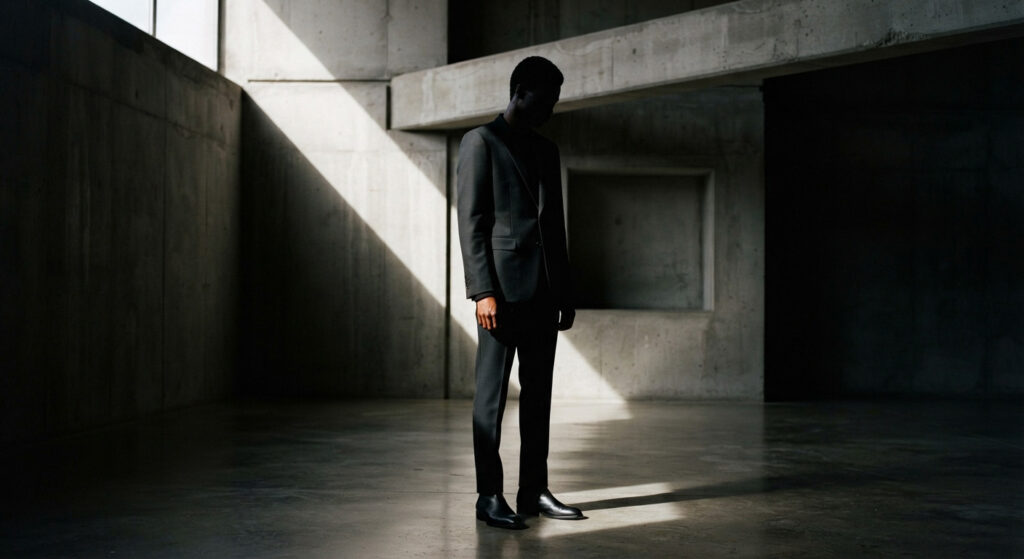
Minimalist fashion, modernist architecture, and brutalist design share a common visual grammar: reduction, geometry, repetition, and restraint. Black, white, grey. Straight lines. Clean surfaces. Defined edges.
This language does communicate something—but not necessarily what it is often assumed to mean.
At a surface level, it signals:
- composure
- discipline
- attention to detail
- social competence
- control over presentation
These signals are not accidental. Human beings are highly sensitive to visual cues, and societies quickly develop “shortcuts” for reading status and behavior. A tailored suit or a monochrome outfit functions as a compressed message: this person understands context and can operate within it.
But a signal is not a psychology. It is a translation.
2. The illusion of the “curated life”
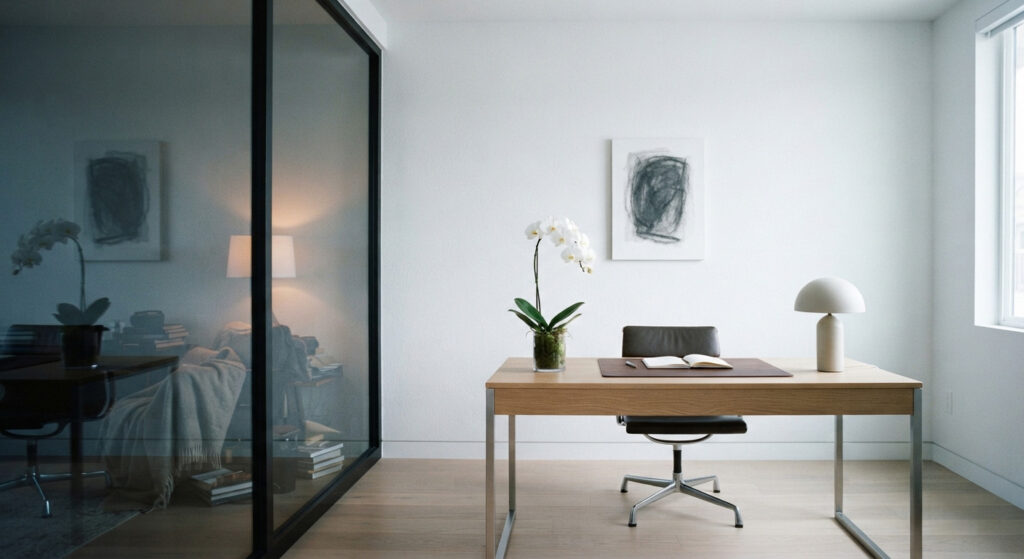
It is easy to look at highly structured aesthetics and imagine a corresponding inner life: orderly, detached, almost insulated from chaos. This is where cultural figures like Miranda Priestly become influential—they embody the fantasy of total control, where emotion is contained, environments are curated, and nothing appears accidental.
From this emerges a common interpretation:
“People who look controlled must live controlled lives.”
But this is where perception and reality diverge.
What is often “curated” is not life itself, but what is allowed to be visible:
- emotions are not eliminated, but selectively expressed
- chaos is not absent, but managed
- vulnerability is not gone, but private
In other words, control is often a matter of interface, not essence.
3. Nature as the opposite pole
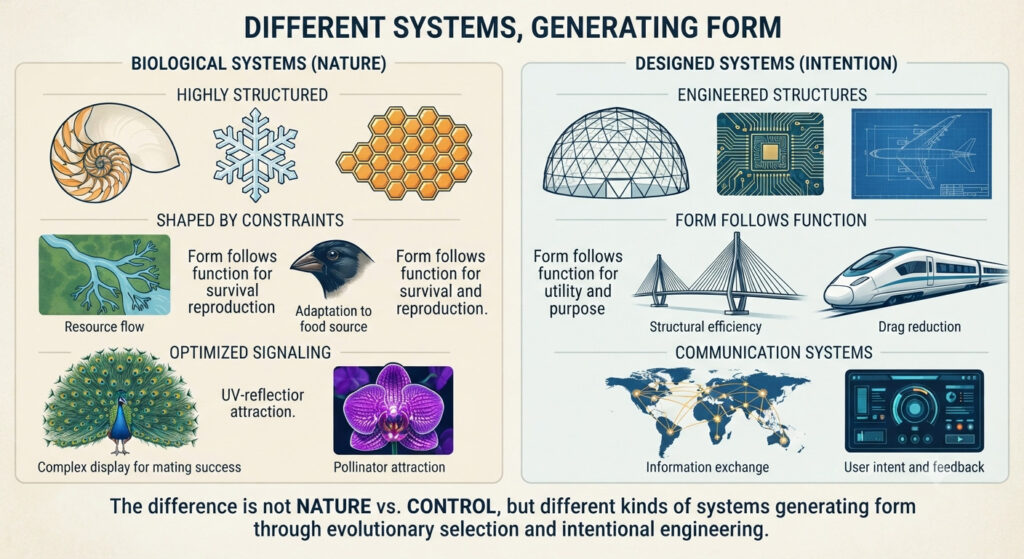
The contrast with nature feels intuitive. Leaves, skin, waves, and landscapes appear unstructured, colorful, and irregular. They give the impression of being “unfiltered,” as if reality itself is more honest when it is not shaped by intention.
But even this comparison is partly symbolic.
Nature is not simply “free expression.” It is also:
- highly structured (fractals, symmetry, patterns)
- shaped by constraints and selection pressures
- optimized over time for survival and signaling
A peacock’s tail is not “pure spontaneity.” It is a biological signal system. A flower’s color is not neutral expression; it is communication.
So the real difference is not nature vs control, but:
different kinds of systems generating form
4. Why controlled aesthetics feel “less alive”
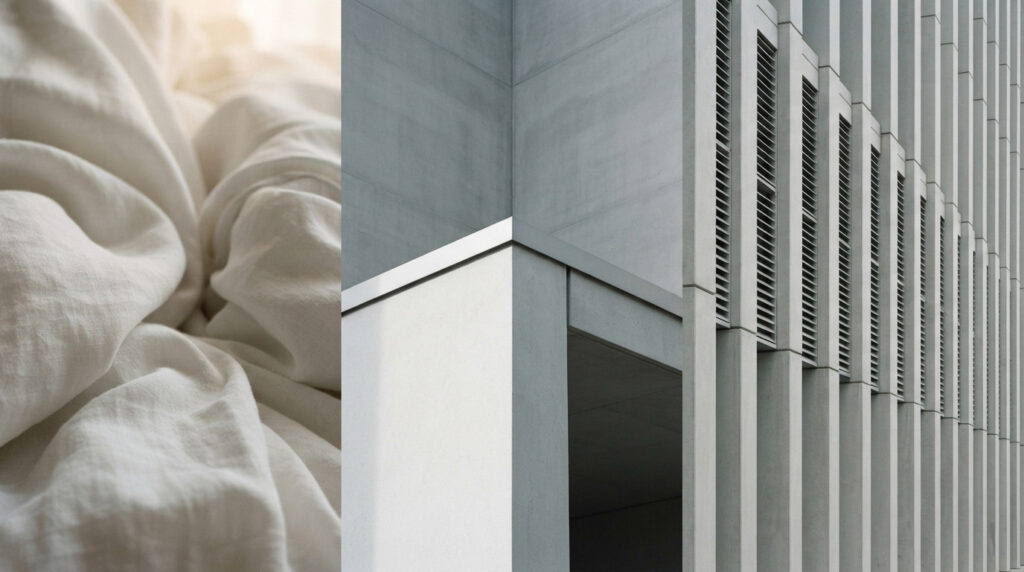
The feeling of emotional distance from minimal or rigid design is real, but it comes from perception rather than essence.
Human cognition tends to associate:
- curvature → softness, life, fluidity
- sharp angles → rigidity, abstraction, authority
- repetition → order, suppression, system
These associations are deeply embedded in how we interpret the world. So when we see controlled aesthetics, we often feel reduction of life—even when no life has been reduced.
This is a perceptual effect: compression of visual information into simplicity can feel like emotional compression.
But simplicity is not absence.
5. Control as adaptation, not concealment

A crucial correction to the “curated and untouchable” interpretation is that control is not always defensive or performative. It often emerges as adaptation.
People adopt structured aesthetics for many reasons:
- reducing cognitive overload
- aligning with professional environments
- preference for clarity and order
- cultural conditioning
- aesthetic taste independent of signaling
In complex societies, structure is often functional. It allows coordination, predictability, and shared understanding.
What looks like emotional distance may simply be efficiency in presentation.
6. The real tension: expression vs legibility

Underneath the entire discussion is a deeper tension:
- Expressive systems: organic, varied, emotionally immediate, harder to decode
- Legible systems: structured, simplified, socially readable, easier to interpret
Nature often appears expressive. Modern aesthetics often aim for legibility.
Neither is inherently more “real.” They serve different needs:
- expression communicates richness
- legibility enables coordination
Human culture constantly oscillates between the two.
7. What the “curated life” idea reveals about us

The belief that controlled aesthetics imply controlled lives reveals something important: a desire to read inner states from outer form.
It is comforting to assume coherence:
- beautiful order → stable mind
- chaos → emotional turbulence
- minimalism → detachment or superiority
But human beings rarely match their visual codes so cleanly. The same person can be highly structured externally and internally unstable, or visually expressive and internally disciplined.
Aesthetic style is not a psychological X-ray. It is a chosen interface.
OUR SPONSOR OF THE DAY : NEONNIGHT.FR
Conclusion
The intuition that “control aesthetics = emotional distance from life” captures a real perceptual experience: structured design feels different from organic form, and that difference is meaningful.
But the interpretation becomes too absolute when it turns into identity judgments about the people behind those aesthetics.
Control in fashion, architecture, and design is not the absence of life. It is one way of organizing how life is shown, filtered, and shared in complex social environments.
The contrast with nature is not between authenticity and falseness, but between two kinds of order:
- one generated without intention
- one generated through intention
And both, in their own way, are expressions of life rather than its negation.


GIPHY App Key not set. Please check settings