
 dudeoi
Triangle of Sadness is a satirical film released in 2022, written and directed by Ruben Östlund, which won the Palme d’Or at the Cannes Film Festival.
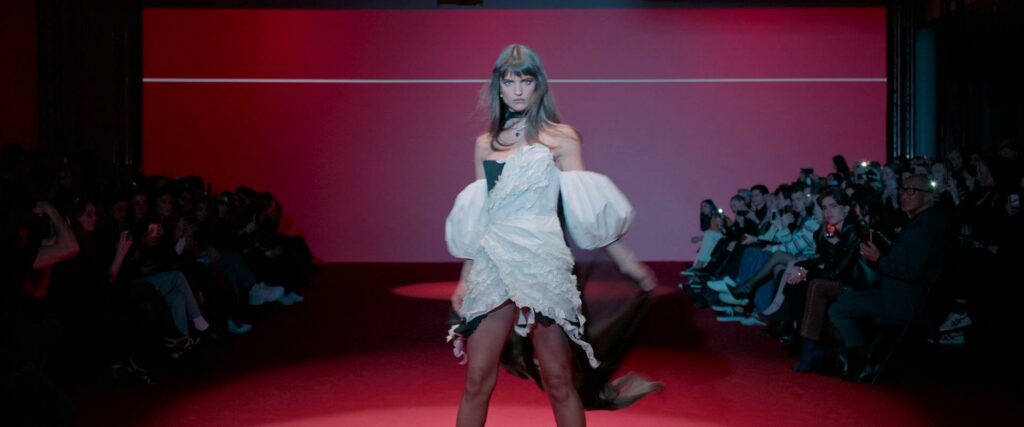
The film explores several sharp themes, most notably the mechanics of social hierarchy and how status is constructed, performed, and ultimately destabilized under pressure.

OUR SPONSOR OF THE DAY : NEONNIGHT.FR

Quick plot

Triangle of Sadness follows a young celebrity couple both working in the fashion and influencer world who are invited on a luxury cruise with extremely wealthy passengers. What starts as an ultra-luxurious experience gradually exposes tensions between guests, staff, and social roles.
As the journey continues, the film uses this setting to explore shifting power dynamics, class differences, and how status behaves in extreme environments.
The themes
1. Wealth and class as performance
On the yacht:
- the rich act refined, entitled, superior
- service workers must perform obedience (jumping in the pool)
- luxury is a stage set for hierarchy
Core idea:
Wealth is not just possession, it is a role people perform
2. Beauty as currency (and fragility of it)

The models represent:
- Beauty as economic capital
- Social value tied to appearance
- Dependence on external validation
But on the island:
- Beauty loses power
- Physical survival matters more
Core idea:
Beauty is powerful socially, but not structurally
3. Reversal of hierarchy

Once survival begins:
- The toilet cleaner becomes leader
- The rich lose authority
- Survival skills replace status
Core idea:
Hierarchy is context-dependent, not absolute
4. Capitalism and dependency

The film shows:
- Wealth depends on invisible labor
- Luxury depends on maintenance systems
- Elites rely on people they ignore
Core idea:
Those who appear powerful often depend on those they overlook
5. Identity collapse under pressure

Characters are defined by roles:
- Model
- Billionaire
- Staff worker
But when structure disappears:
- Identities break down
- Behavior becomes raw and survival-based
Core idea:
Identity is fragile without supporting systems
6. The absurdity of status systems

The film exaggerates social rituals to show:
- How arbitrary status signals are
- How ridiculous luxury norms can become
- How much we accept as “normal” without questioning it
7. The workers are expected not only to serve, but also to remain invisible

In Triangle of Sadness, the topless crew member scene shows how tightly visibility is controlled on the yacht.
- Workers are expected to be invisible, uniform, and background presence
- The crew member becomes “too visible” by appearing shirtless, even though he is simply working
- His body disrupts the hierarchy where only guests are meant to be seen and admired
- As a result, he is disciplined and fired
The scene highlights a key idea: in this system, workers are not just meant to serve—they are meant to disappear.
8. The ending

Throughout the film, hierarchy is based on wealth, beauty, and social roles. On the island, these reference points collapse and positions can be reversed.
In this context, Abigail’s action can be interpreted as a defensive response: an attempt to avoid falling back into a subordinate position and to preserve a hierarchical order that grants her a higher social status—and therefore access to respect, recognition, beauty, and even the admiration of her peers (When Yaya compliments her matriarchy). Perhaps the most important one is to be able to negotiate with constraints instead of enduring them.
Thus, the film does not only show the fragility of hierarchical systems, but also their internal persistence: their ability to protect themselves, sometimes at the cost of morally questionable actions.
9. Why Triangle of Sadness

The title Triangle of Sadness comes from a cosmetic term describing the wrinkle between the eyebrows that forms when frowning, often linked to stress and aging.
In the film, it becomes a symbol rather than a medical detail:
- Surface level: beauty standards and pressure to look perfect
- Deeper level: social class, power, and inequality
- Core idea: value and status are artificial and unstable
Ultimately, the “triangle of sadness” represents how external appearances reflect deeper emotional and social tensions. Perhaps it also have a word games with the Bermuda Triangle referring to the sinking of the micro society in the ship.
The Economy of Identity: Why people buy what they want to represent or who they want to become

In modern society, people rarely buy things for purely practical reasons. Beyond food, shelter, and basic tools, most purchases are tied directly or indirectly to identity. A watch is not just a timekeeping device.
A pair of shoes is not just protection for the feet. A book is not always read. These objects function as signals, anchors, and projections of who we are or who we want to be.
To understand this, we need to move beyond the idea that consumption is about utility. Much of it is about identity construction.
1. Identity as a Psychological Need

Every individual faces a fundamental question: Who am I?
This is not a trivial or abstract concern—it is a core psychological need. Humans are social beings, and identity helps situate us within a group. It provides coherence, direction, and meaning.
In earlier societies, identity was largely inherited:
- Family
- Profession
- Social class
- Geography
Today, those structures are more fluid. As a result, individuals must actively construct their identity. This creates a vacuum—and markets fill that vacuum.
Objects, brands, and experiences become tools for self-definition.
2. Consumption as a Signaling System

Modern consumption operates as a language.
People use visible choices to communicate invisible traits:
- Wealth
- Taste
- Discipline
- Intelligence
- Belonging
A tailored suit can signal competence. A minimalist apartment can signal control and refinement. A rare collectible can signal knowledge and access.
These signals are efficient. Instead of explaining who we are, we show it.
But signaling has a consequence: it prioritizes appearance over substance. The signal can exist without the underlying reality.
3. The Shortcut Problem

Purchasing identity is attractive because it is fast, cheap and risk free.
Becoming skilled, disciplined, or respected takes time and effort. Buying something associated with those traits is immediate.
- Instead of becoming an artist → buy artistic objects
- Instead of building wealth → display symbols of wealth
- Instead of mastering a craft → adopt its aesthetic
This is not always conscious deception. Often, it is aspirational. People buy into a version of themselves they hope to grow into.
However, this creates a gap: the difference between symbolic identity and lived identity. The wider the gap, the more fragile the identity becomes.
4. Why It Feels Real

Even when identity is constructed through objects, it still feels meaningful.
This is because:
- Others respond to signals
- Some social environments reinforce them
- Internal perception shifts accordingly
If people treat you as successful, refined, or knowledgeable, part of that identity becomes real—at least socially.
In this sense, identity is partly negotiated, not purely intrinsic.
5. Markets Built on Identity

Entire industries operate primarily on identity rather than function:
- luxury goods → status and exclusivity
- fashion → belonging and differentiation
- collectibles → knowledge and rarity
- finance → intelligence and foresight
- fitness → discipline and control
These markets are powerful because they connect directly to self-perception. They do not just sell products—they sell positions in a social hierarchy.
6. Why Some People Don’t Play the Game

Not everyone relies heavily on identity through consumption. Those who resist it often have alternative sources of identity:
- Internal clarity
They have a stable sense of self that does not require external reinforcement. - Action-based identity
Their identity comes from what they do—skills, work, output—rather than what they display. - Low sensitivity to social signaling
They are less influenced by how others perceive them. - Awareness of the mechanism
Once you see signaling clearly, its emotional pull weakens.
However, it is important to note:
even rejection of status can become a form of identity (minimalism, anti-consumerism, etc.)
No one is entirely outside the system—only positioned differently within it.
7. The Tension: Being vs Appearing

At the core of this phenomenon is a tension:
- Being → grounded in action, skill, and reality
- Appearing → grounded in perception, symbols, and narrative
Modern environments often reward appearance in the short term. But over time, reality tends to assert itself. In repeated interactions, production and competence become harder to fake.
This is why some forms of identity collapse under pressure, while others strengthen.
8. A More Precise Understanding of Value

Not all identity-based consumption is meaningless.
There are two types of value:
- Functional value → improves your life directly
- Symbolic value → shapes perception and identity
Problems arise when symbolic value replaces functional or experiential value entirely.
Healthy identity investment:
- Aligns with real behavior
- Supports growth
- Reflects actual engagement and real sacrifices
Unhealthy identity investment:
- Substitutes for action
- Depends heavily on external validation
- Creates a gap between reality and presentation
Examples:
A world heavyweight champion may spend years in training, often sacrificing personal milestones such as his children’s birthdays and holidays. His identity is shaped through sustained exposure to physical discipline, risk, and measurable performance.
In contrast, other forms of identity formation rely less on direct confrontation with reality and more on symbolic construction—through image, style, and social signaling. In these environments, status is often validated through perception rather than sustained output.
Similarly, artistic identity can emerge through repeated exposure to rejection, constraint, and resistance, where value is gradually tested against reality through creation and audience response. Other identities, however, may be primarily expressed through adopted aesthetics and social roles rather than production.
9. Reality vs System

Testing in reality
- direct confrontation (audience, market, performance)
- concrete constraints
- measurable results
Identity is validated by what works
Testing in systems
- social media, social codes, image
- recognition and perception
- status signals
Identity is validated by what is recognized
Synthesis
- Systems judge perception
- Reality judges performance
10. Core insight

People do not simply buy objects they buy narratives about themselves.
This is not a flaw; it is a structural feature of human psychology and social life. Identity must be constructed, and markets provide the materials.
This is why consumers are willing to pay a premium for a product that serves the same need, and in some cases, is even identical products. This is why some people are willing to trade all their money and time for signals without substance.
The real question is not whether identity influences consumption it always does.
The question is: Is identity being built through reality, or simulated through symbols?
The answer determines whether what is being built is stable or merely performed.
OUR SPONSOR OF THE DAY : NEONNIGHT.FR
Conclusion

Triangle of Sadness reveals that hierarchy, wealth, and status are not fixed realities but performative systems that depend on context and collective agreement. When those supporting structures collapse, so do the identities built on them.
This connects directly to the broader logic of identity in modern society: people do not only consume for utility, but to construct and signal who they are. Yet these signals remain fragile, because they rely on recognition and stable environments.
Ultimately, both the film and everyday social life point to the same tension: identity can be performed through symbols, but only tested and sometimes broken by reality.
The film suggests that human competition is driven not only by access to resources, but also just as much by position within a social hierarchy: who is dominant, and who is subordinate.


GIPHY App Key not set. Please check settings