
 dudeoi
American Psycho is arguably one of the most bizarre yet captivating films of our generation just like Fight Club. When I watched this movie young, I couldn’t quite explain what hypnotized and disturbed me at the same time. As I grow older, it becomes increasingly obvious.
While Patrick Bateman is undeniably a lunatic, there’s a disturbingly relatable side to him that makes viewers uncomfortably introspective.
In this article, we’ll explore why Patrick Bateman may be closer to us than you would want to admit.


OUR SPONSOR OF THE DAY : NEONNIGHT.FR
The plot

Set in 1980s Manhattan, American Psycho follows Patrick Bateman, a wealthy and successful investment banker who hides a dark secret: he’s a violent sociopath.
Obsessed with status, appearances, and materialism, Bateman navigates a superficial world of wealth and excess while spiraling into increasingly brutal acts of murder.
The film blurs the line between reality and Bateman’s twisted imagination, leaving audiences questioning what is real and what exists only in his disturbed mind.
Legibility

We’ll use the term “legibility” to describe symbols that are easily readable — forms whose meaning is pre-agreed upon and socially standardized.
For example, wearing a Ralph Lauren polo or a Rolex functions as a symbol of upper-middle-class respectability and economic legitimacy. These items carry significance not because of anything intrinsic to them, but because society has collectively agreed to assign them meaning. Legibility always borrows meaning: it relies on shared recognition, cultural consensus, or symbolic systems created and maintained by others.
Legibility carries no inherent value judgment; it exists as a shortcut for social recognition and belonging. By borrowing pre-existing pre-packaged meaning, legible signals allow individuals to communicate status, alignment, or identity without having to generate it from scratch. The power of legibility lies precisely in this borrowed clarity — it is readable, recognizable, and instantly digestible — but that also makes it dependent on external frameworks, not internal authenticity.
Why using legible message helps

Using legible messages helps because humans are social pattern-recognition machines. In any group, people are constantly scanning for cues that answer simple questions: Is this person safe? Do they belong? Are they like us? Legible symbols — familiar opinions, recognizable aesthetics, or shared narratives — compress those answers into something instantly readable, reducing uncertainty and effort. They also lower social friction: messages that fit accepted frameworks reassure rather than challenge, travel faster, receive more approval, and provoke less resistance.

Legibility also provides psychological comfort. For the sender, it offers approval, validation, and a sense of being “on the right side.” For the receiver, it provides predictability and a clear framework for interpretation. Shared, legible symbols help coordinate large groups and make collective life possible at scale. The tool becomes problematic only when it replaces authenticity, courage, or lived experience, rather than serving as a bridge to them.
Why using only legible symbols hurts

Relying solely on legible messages comes at a cost: authenticity is sacrificed for recognition. When every word, image, or action is curated to be instantly readable and socially approved, the unique self — perspective, insight, or feeling — is muted. Life becomes a performance, approval is received, but presence and meaning are lost, and influence remains shallow. Messages that confirm what people already expect avoid risk, but also avoid growth, both for the sender and the audience.

Dependence on borrowed symbols also creates vulnerability. Status is only as secure as the recognition it draws, and others can easily mimic or overshadow it. Over time, a life built solely on legibility erodes courage, boldness, and the ability to act from internal alignment. Authentic influence and creativity arise from owning one’s values and perception (for example a sense of humor that no one else has), not repeating what is easily digestible (for example posting an instagrammable post). Legibility is safe; authenticity carries risk — but it is the only path to depth, presence, and real resonance.
The Relation Between Legibility and Patrick Bateman

Patrick Bateman is the ultimate example of life lived entirely for legibility, with no one behind the façade. Every detail — clothing, grooming, apartment, workouts, and social rituals — is carefully curated to be instantly readable and appreciated. On the surface, he appears perfect: successful, polished, admired, and socially “correct.” He has mastered borrowed legitimacy, projecting status, wealth, and taste that everyone immediately recognizes.
The symbolic arena
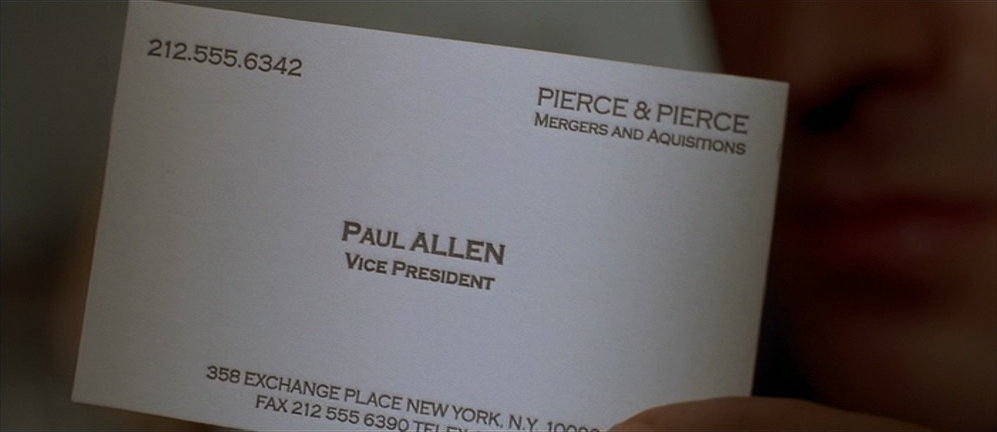
Yet Bateman is trapped in a symbolic arena. The business card scene shows how he must compete where value is measured not by skill or insight, but by socially agreed-upon symbols. Every interaction rewards symbolic mastery over authentic expression (even conversations are pre-packaged), leaving him frustrated and hollow. His life illustrates the extreme consequences of relying solely on external legibility: visible success, but fragile, empty, and dependent on others’ recognition.
To be fair, all his colleagues are essentially indistinguishable and interchangeable, which is why they often confuse themselves with one another.
Life in an abstract world

While few of us commit literal violence, many of us borrow symbols and perform roles, suppressing true drives — a reminder that even secret desires for agency can become distorted when constrained to socially approved scripts.
The title “American Psycho” captures how Patrick Bateman’s extreme legibility—perfectly curated outward appearances built on borrowed symbols—masks a hollow, unaligned inner self, dramatizing the psychological cost of living entirely for social approval.
There is an idea of a Patrick Bateman; some kind of abstraction. But there is no real me: only an entity, something illusory. And though I can hide my cold gaze, and you can shake my hand and feel flesh gripping yours and maybe you can even sense our lifestyles are probably comparable… I simply am not there.
Legibility Today

Social media is today’s arena of legibility. Posts, images, and captions are often crafted to be instantly readable and widely understood (socially approved to generates the most possible likes).
Because attention spans are short, the message must be grasped within seconds. Luxury items, travel photos, family posing or carefully styled content function as symbols that communicate belonging or taste — familiar markers that are easy for others to interpret and digest but says nothing genuine nor original about the sender.
Many people hesitate to show their true selves. Honest or polarizing perspectives can feel risky, because they may not fit pre-existing social expectations. As a result, much of what is shared emphasizes clarity and recognition over personal nuance or vulnerability. Nothing should be challenging; everything should remain easy and fit the platform’s context, to escape from nuanced reality.

The effect is subtle but real: while social media can connect and inspire, it can also encourage communication that is highly legible yet not fully aligned with one’s inner experience. Authenticity and presence exist, but they are often quieter, woven beneath the visible symbols that everyone can understand.
While legibility is highly effective at selling expensive symbols to those who wants to send quick signals or sometimes manufacture a digestible identity, it also functions as a machine that compresses people into façades of what is socially acceptable.
Are you posting a picture because:
- You want to document a memory for yourself, independent of others’ opinions.
- You genuinely want to express your point of view or perspective.
- You want to capture and share an authentic experience.
- You aim to provoke thought or evoke emotion.
- You’re seeking approval, likes, or validation.
- You want to signal status, taste, or belonging.
- You’re following trends or imitating popular styles.
- You hope to be perceived as creative, talented, or interesting.
- You’re afraid of showing something challenging or unconventional.
Authenticity vs Legibility

First, it’s important to understand that humans, as social beings, need both—each in its own balance.
Legible
- Definition: Easily recognized and understood by others; signals designed to be “read” by society.
- Focus: External perception, social approval, and visibility.
- Motivation: To be noticed, admired, or envied; to communicate status, taste, or power.
Characteristics:
- Obsession with appearances, possessions, or trends
- Actions performed to signal wealth, style, or social belonging
- Socially coded symbols (luxury brands, expensive cars, elite clubs)
Risk: Can lead to emptiness because the self is shaped by what others see, not who you are internally.
Authentic
- Definition: True to oneself; aligned with personal values, desires, and inner convictions.
- Focus: Internal experience, self-expression, and integrity.
- Motivation: Fulfillment, purpose, and meaningful connections.
Characteristics:
- Actions stem from personal values, not social pressure
- Pursuit of skills, relationships, and goals that resonate deeply
- Expression of individuality and inner authority
Benefit: Creates lasting satisfaction and resilience, because identity is self-directed rather than socially dictated.

Legible Symbols of Success (Surface, Socially Readable)
- Recognizable but “tasteful” clothes brands
- Buying a posh car using a credit
- Owning an apartment or house in a “good but lifeless neighborhood”
- Stable corporate or professional job with a clear title (consultant, manager, engineer, analyst)
- Degrees and certifications that isn’t rare
- Dining at hype places
- Traveling only to socially approved destinations (ex: France to signal taste)
- Prestigious private elementary school for children instead of saving for a prestigious college or even a vocation
Inner Sense of Success (Authentic, Internally Driven)
- Mastery of a craft or skill pursued out of genuine passion
- Deep, meaningful relationships and mutual trust
- Emotional intelligence and self-awareness
- Integrity and consistency between values and actions
- Freedom to make choices based on personal priorities, not social pressure
- Contribution or impact that aligns with personal principles
- Physical and mental well-being maintained for self-care, not display
- Sense of purpose or fulfillment in daily life
- Resilience and adaptability in the face of challenges
- Inner peace and satisfaction independent of external validation
Social Intelligence vs Legibility

Legibility sends clear, socially recognized signals to be quickly understood and approved, whereas social intelligence involves perceiving others, understanding the context, and responding with nuance and authenticity.
Legibility reassures and simplifies, but can reduce interactions to predictable scripts; social intelligence, less visible but deeper, creates genuine connections and lasting influenc
OUR SPONSOR OF THE DAY : NEONNIGHT.FR
Conclusion

Patrick Bateman, and people who exist only through symbols without any inner foundation, are largely fictional extremes.
In reality, no one is completely detached from their inner life. Even the most performative individuals still have feelings, desires, memories, and values — fragments of self that exist beneath the surface.
What Bateman dramatizes is an extreme magnification of tendencies we all share: relying heavily on borrowed legitimacy, seeking approval, and competing in symbolic arenas.
In other words, Bateman doesn’t exist as a literal person, but as a mirror for human behavior. He makes visible what most people experience subtly: the tension between legibility and authenticity, the temptation to perform rather than be, and the ways secret desires for agency or dominance are constrained by social norms.
His extreme emptiness is a thought experiment — a lens for understanding the costs of leaning too heavily on symbols instead of cultivating inner alignment.

There are no more barriers to cross. All I have in common with the uncontrollable and the insane, the vicious and the evil, all the mayhem I have caused and my utter indifference toward it I have now surpassed.
My pain is constant and sharp, and I do not hope for a better world for anyone. In fact, I want my pain to be inflicted on others. I want no one to escape. But even after admitting this, there is no catharsis; my punishment continues to elude me, and I gain no deeper knowledge of myself. No new knowledge can be extracted from my telling. This confession has meant nothing. Patrick Bateman


GIPHY App Key not set. Please check settings