
 dudeoi
Gone Girl, directed by David Fincher and released in 2014, is my favorite film in his entire filmography. Adapted by Gillian Flynn from her own novel, it is a thriller on the surface and something much stranger underneath.
What makes it so remarkable is how seamlessly its deeper themes are woven into the story. We become so absorbed in the characters and their deceptions that we forget the film is holding up a mirror to our own lives.
At its core lies a simple, uncomfortable subject: the art of performing for validation, and the parts of ourselves we hide in the process.


OUR SPONSOR OF THE DAY : NEONNIGHT.FR
The plot

Nick Dunne’s life turns upside down when his wife, Amy, disappears on their fifth wedding anniversary. As the investigation unfolds, mounting evidence casts suspicion on Nick, while the media turns their marriage into a public spectacle. But as the truth emerges, the story reveals itself to be far more disturbing than a simple case of a missing woman.
The mystery is only the vehicle. The real subject is the distance between who people are and who they present themselves to be.
Amazing Amy
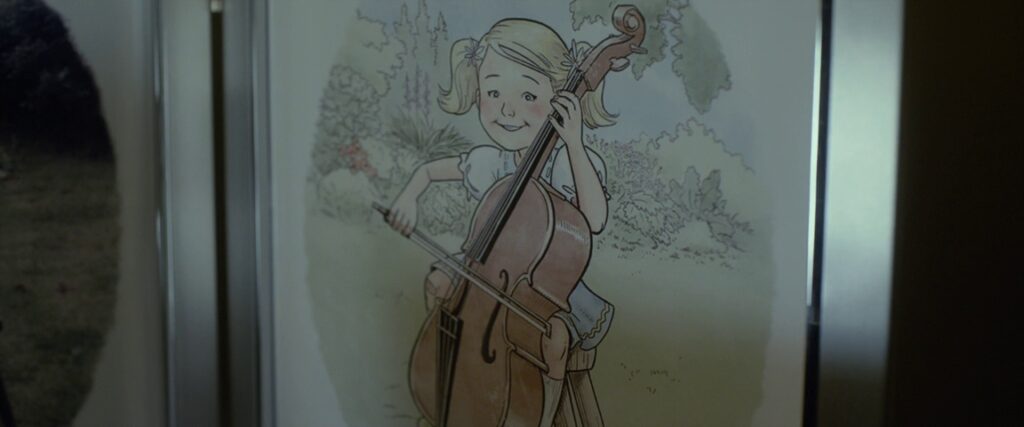
Amazing Amy is a fictional character created by Amy Elliott Dunne’s parents, inspired by their daughter’s life but perfected into an aspirational ideal. The real Amy grows up in the shadow of a better version of herself, one who plays the cello, wins the contest and never disappoints.
In this sense, Amazing Amy is a literal illustration of what a persona is designed to be: an improved version of ourselves, stripped of our flaws and reshaped into someone worthy of admiration. Before Amy ever learns to perform for the world, she learns to perform for the two people whose love she most wants to keep.
Cool Girl

Amy Elliott Dunne does exactly the same thing with her own identity. She adapts her persona to her environment, revealing only the version of herself most likely to produce the desired reaction. At a party, she can be the intelligent, attractive, effortlessly captivating woman.
When she meets Nick, she becomes the ideal partner, the Cool Girl, carefully presenting herself as the woman he wants to fall in love with. In her now-famous monologue, she describes the type with merciless precision: Cool girl is hot. Cool girl is game. She shapes her tastes, her body and her moods around whatever he seems to like, and never lets anger show.

The confession that follows is the key to the whole film: the woman Nick loved never existed. She was an act performed so well that it earned a marriage.
And when she stages her disappearance, she builds an entirely different persona: the innocent, vulnerable, pregnant wife whose story will captivate the police, the media and the public.
The character changes, but the objective stays the same: to control how others perceive her by giving them exactly what they want to see. Amy doesn’t simply lie about who she is. She understands that different audiences desire different versions of her, and she is willing to become all of them.
Nick Dunne

Nick is no different. He, too, adapts his persona to suit his environment, presenting himself as the charming, witty, easygoing man he believes others want him to be (He writes advice columns for men’s magazines). He uses that charm to win Amy, but as the marriage deteriorates, the gap between the man he pretends to be and the man he actually is becomes impossible to hide. Eventually, he simply stops performing the ideal husband.

When Amy disappears, Nick faces a new audience: the police, the media and millions of strangers who will judge him on his appearance. He quickly learns that being innocent isn’t enough; he must also look innocent. The smile he lets slip at a press event costs him more than any piece of evidence. From then on, he learns to adjust his expressions, control his reactions and deliver the grieving husband the public expects to see. He even hires a lawyer partly to coach that image.
Where Amy engineers her persona, Nick improvises his. But both understand that survival depends on performance. Neither is trying to be liked anymore. They are trying to control the narrative others construct about them, in a world where the appearance of being a good person can matter as much as being one.
The purpose of a persona

A persona serves a fundamental purpose in social life: to make us desirable to others. We learn to emphasize the qualities that earn admiration, conceal those that invite rejection, and adapt our behavior to the expectations of the people around us. Whether we want love, friendship, professional success or status, we understand that how we present ourselves shapes what we receive.
The problem is that these adaptations rarely stay superficial. We begin by modifying how we express ourselves, and eventually we modify what we express. We hide desires that might make us less appealing, adopt opinions that make us more acceptable, and pursue ambitions that give us the identity we want others to recognize. The persona becomes a filter through which we experience the world, separating what we genuinely want from what we believe we should want.
The persona is not necessarily a lie. It is the version of ourselves we have learned will be rewarded. And the better it serves us, the harder it becomes to tell the person we constructed to navigate society from the person we might have been without the need for its approval.
Amy’s diary

Fincher uses the very mechanism his film explores to deceive us. Through Amy’s diary, he builds a seemingly intimate account of a marriage falling apart, leading us to see Nick as a cruel, unfaithful husband and Amy as his innocent victim.
We believe it because it gives us exactly what we need to judge them. Then the truth emerges and our perception reverses: the woman we pitied becomes someone we fear, and the man we despised becomes the victim of her manipulation.

What is fascinating is that we fall in love with their personas while hating the real people behind them. We admire Amy’s intelligence and composure, Nick’s charm and vulnerability, even as we discover the darker realities those qualities conceal.
By making us live the deception firsthand, Fincher shows how easily we confuse a convincing performance with a genuine person. We don’t simply observe others; we construct stories about them, then mistake those stories for the truth.
We think we are watching Amy and Nick perform for the world, unaware that we are the audience they have been performing for all along.
And this is precisely why concealing the truth so often becomes a necessity.
The world rejects truth

People often prefer the performance because it offers a version of reality that is easier to understand, admire and accept than the truth. A persona is coherent, attractive and reassuring, while a real person is full of contradictions that challenge our expectations.
We don’t necessarily want to know who someone truly is; we want them to embody the qualities we value. The most uncomfortable part is that we take part in this deception ourselves, rewarding others for playing their roles while carefully maintaining our own.
The world doesn’t reject truth for its own sake. It rejects what the truth threatens: people’s self-image, their place within a group, and the narratives that make their lives coherent.
Society rewards what is recognizable, reassuring and socially acceptable. A convincing performance can therefore be worth more than genuine integrity, because it gives people what they want to see rather than what they might need to confront.
Perhaps the world doesn’t reject truth so much as the price of acknowledging it.
The paradox of performing for rewards

From an early age, we learn that certain behaviors earn affection, admiration and recognition, while others invite rejection. We gradually adapt our appearance, opinions, ambitions and even our personalities to what seems most likely to be rewarded. Psychology describes this through ideas such as social conditioning and impression management, a concept associated with sociologist Erving Goffman: we learn not only how to behave, but how to present ourselves in order to influence how others see us.
The trouble begins when we lose the distinction between what we genuinely desire and what we have learned to desire because it makes us desirable. We pursue status, wealth, attractive partners and professional success not necessarily for their own value, but for what they seem to prove about us. We stop pursuing things for what they give us and start pursuing what they say about who we are.

This helps explain why achievements can feel strangely empty. Research on hedonic adaptation shows that our emotional response to positive changes tends to fade as we get used to them. Meanwhile, self-discrepancy theory, developed by psychologist E. Tory Higgins, suggests that the gap between who we are and who we believe we ought to be can feed emotional distress. We may receive the admiration we worked so hard to earn while feeling increasingly disconnected from the person who earned it.
The paradox is that the performance works. Society rewards us, opportunities open up, people admire us. Yet those rewards cannot satisfy the needs we sacrificed to obtain them. We wanted to be loved, but learned to be desirable. We wanted to feel worthy, but learned to collect evidence of our worth.
OUR SPONSOR OF THE DAY : NEONNIGHT.FR
The final performance

The film’s ending is its coldest joke. Amy returns, stages a new story, and Nick, who knows the truth, cannot expose her without destroying himself. They stay together, performing the perfect couple for the cameras. The marriage that began as two performances ends as a shared one, maintained because the audience demands it.
It is a bleak image, but not an unfamiliar one. Many of us keep up a version of that arrangement with our friends, our colleagues and sometimes our partners.
We spend our lives becoming the person others want us to be, only to discover that their approval cannot tell us whether we have become the person we wanted to be.


GIPHY App Key not set. Please check settings