
 dudeoi
Collateral is a 2004 neo-noir thriller by Michael Mann, the director behind Heat. It’s a film I’ve returned to countless times, drawn in by its hypnotic atmosphere, striking visuals and fascinating ideas about human nature.
On the surface, it’s a simple premise: a cab driver picks up a hitman for what turns into a long, deadly night across Los Angeles.
But beneath the gunshots and neon-lit streets lies something far more unsettling: a film about wasted lives, unrealized ambitions, moral compromise and the dangerous illusion that we’re in control of our own existence.

Today, let’s look beyond the thriller and explore what Collateral is really about.
The plot

Set over a single night in Los Angeles, Collateral follows Max, a cab driver whose ordinary shift takes a sinister turn when he picks up Vincent, a mysterious passenger who turns out to be a contract killer.
What begins as an unusually lucrative fare quickly becomes a nightmare when Max discovers he’s being forced to drive Vincent between murder targets.
Trapped in the cab, he must find a way to survive the night—and confront the man he’s spent years avoiding confronting.
The themes
Stagnation versus decisive action

Max has deferred his dream of a limo company for years and mistakes routine for a life. Vincent is the opposite, acting without hesitation. The film asks whether being alive means functioning or choosing how to live.
Alienation and anonymity in the modern city

Los Angeles at night is beautiful and lonely: people are physically close and emotionally cut off. The man who rides the subway dead for hours without anyone noticing is the clearest image of this.
Identity defined by work

Max thinks of himself as a taxi driver and Vincent as a professional killer, and each uses the job as a mask. Their night together breaks both self-images.
Freedom versus responsibility, nihilism versus humanity

Vincent has a radical freedom with no attachments and no moral obligation, and it is destructive. Max is held back by fear but keeps his conscience. The question is whether freedom without responsibility is really freedom.
Chance, fragility and control

Vincent tries to control everything, while Max reacts to events. A random encounter drives the whole plot, and life can be ended or changed by an unexpected moment.
The double or shadow

Vincent works as a dark mirror and catalyst for Max, forcing him to find the decisiveness he has been suppressing. Each man has what the other lacks: Vincent has decisiveness, and Max has humanity.
Moral awakening
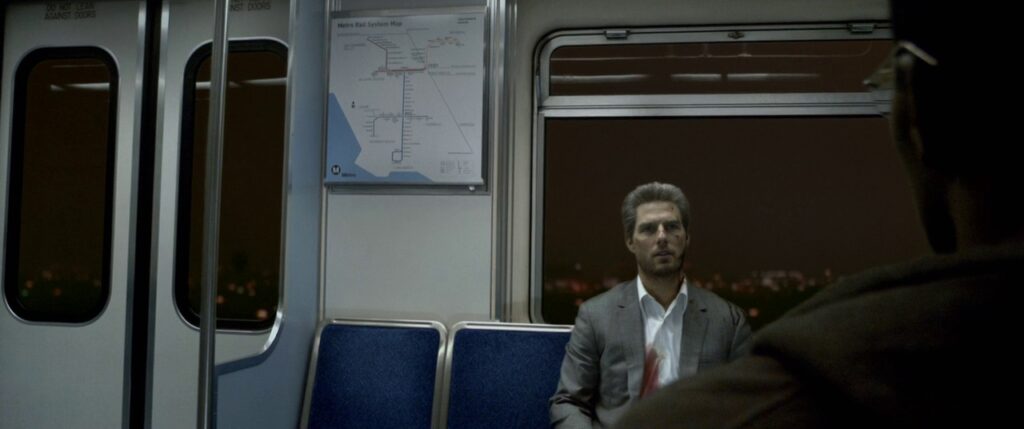
Max moves from passive to active without becoming Vincent. He learns that courage doesn’t require abandoning humanity, and Vincent disappears into the night as anonymously as he arrived.
The overall thesis is that the film warns against living on autopilot, and also against confusing freedom with the absence of moral obligations.

One point is worth keeping from the third text: it frames the story as the competent outsider who forces the protagonist to face what he has suppressed, which is a recurring pattern in Michael Mann’s films. The coyote and jazz-club scenes, which I mentioned, are in only one of the three texts.
Conclusion

Ultimately, Collateral is a film about two men who have taken opposite paths through life, yet are both trapped in their own way.
Max has spent years postponing his ambitions, hiding behind routine and waiting for the right moment to change his life. Vincent, by contrast, acts with absolute conviction, but has stripped his existence of almost everything that makes life meaningful: attachment, empathy and moral responsibility.
Their encounter forces Max to confront an uncomfortable truth: the very qualities he admires in Vincent—his decisiveness, confidence and refusal to hesitate—are inseparable from the qualities that make him so dangerous.
But Max doesn’t need to become Vincent to escape his own stagnation. He needs to find the courage to act while holding on to his humanity.
And perhaps that’s the film’s most interesting idea: you can spend your entire life avoiding the risk of living, or become so detached from everything that life itself loses its meaning.
Somewhere between those two extremes lies the difficult business of actually being alive.
That’s what makes Collateral so much more than a stylish thriller. Long after the night is over, its central question remains: are you actually living your life, or simply passing through it?


GIPHY App Key not set. Please check settings